After the Desk: Testing London's Office-to-Flat Promises in 2026
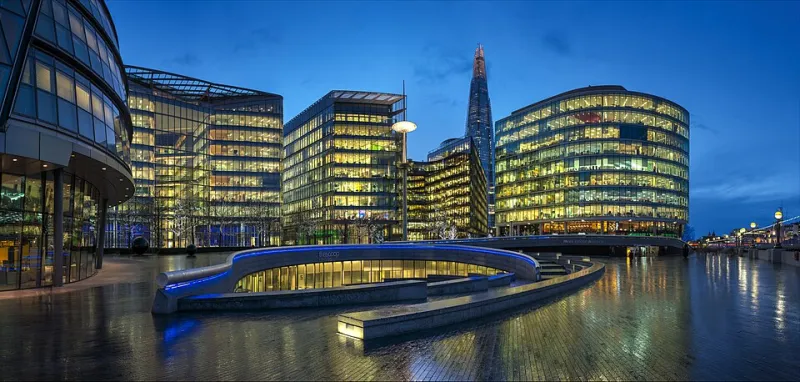
Photo: Diliff, CC BY-SA 3.0, via Wikimedia Commons
On a wet Tuesday in Croydon, the ground floor of a 1980s office building has been rebranded as a residential lobby. The reception desk is still there; the carpet tiles are new. Upstairs, a former open-plan floor has been divided into 14 studio flats. The smallest is 27 square metres. The marketing brochure calls them compact city homes. The planning file calls them dwellings.
Conversions of this kind have become a familiar feature of London's housing supply debate. They are fast, they reuse existing structures and they avoid the long lead times of large regeneration schemes. In a city with a persistent housing shortage, that speed is attractive. But speed is not the same as quality, and a unit is not the same as a home.
LSE London Housing examined prior-approval records and planning files for 16 office-to-residential schemes across Barnet, Brent, Croydon, Hounslow, Newham and Southwark, and visited four completed developments. The sample is not a statistical survey, but it reveals a consistent pattern: conversions are delivering new addresses, often at speed, while raising unresolved questions about space, affordability and community infrastructure.
The promise in the planning file
Many conversions use permitted development rights, which allow a change of use from office to residential without a full planning application. The prior-approval process focuses on specific matters such as transport, noise, contamination and flood risk. It is not a full design assessment, and it does not automatically secure affordable housing or the wider contributions that a conventional planning permission might attract.
That difference matters. A full application for a residential scheme in London will usually be tested against the London Plan, local space standards and affordable-housing policies. A permitted development conversion may bypass some of those tests. Some boroughs have responded with Article 4 directions, removing the right in particular areas, but coverage is uneven. The result is a patchwork in which the same building type can produce very different outcomes depending on which side of a borough boundary it sits.
Planning files often describe conversions as regeneration or urban living. The language is not false, but it is partial. A former office can bring activity back to a tired high street. It can also add residents to an area with no corresponding investment in schools, health services, play space or public realm.
What the units actually look like
At a completed scheme in Hounslow, a 31-square-metre studio has a kitchenette along one wall, a bed behind a half-height partition and a single window facing a busy road. The bathroom is compact but functional. The ceiling height is good, a legacy of the office floor. The ventilation is less convincing: the flat relies on a mechanical system that residents say is noisy at night.
In Croydon, a one-bedroom flat marketed as a starter home measures 38 square metres. The bedroom has no external window. The living area is single-aspect and the kitchen has two ring hobs. The development has cycle storage, but the bin store is shared with a neighbouring commercial unit and overflows on collection days.
These are not unusual findings. Office buildings often have deep floor plates, limited opening windows and glazing designed to manage solar gain for workers rather than residents. Converting them into homes requires careful design. When the priority is maximising unit numbers, the result can be a cluster of micro-flats with weak daylight, poor cross-ventilation and little storage.
The affordability question
Conversions are frequently described as helping to meet housing need, but the tenure tells a more complicated story. Many schemes in our sample are market sale or build-to-rent. Some include a small shared-ownership component, often negotiated voluntarily rather than required by policy. In permitted development schemes, there is frequently no section 106 affordable housing contribution at all.
That does not mean every conversion is unaffordable. It means the word affordable is doing different work depending on the document. In a marketing brochure, it may mean cheaper than a new-build tower nearby. In housing policy, it should mean linked to local incomes and accessible to households on moderate earnings. The two definitions are not interchangeable.
Residents also report hidden costs. Service charges in converted blocks can be high because lifts, communal corridors and mechanical systems serve relatively few units. Energy performance varies. A flat that looks cheap to buy may be expensive to heat, cool and maintain.
Community infrastructure and the missing middle
The most consistent gap in the schemes we reviewed was not the front door. It was what lies beyond it. New residents arrive with the same needs as anyone else: GP appointments, school places, a playground, a library, a place to meet. Conversions add population without always adding the infrastructure that makes a neighbourhood work.
In one Newham scheme, residents said they had struggled to register with a local GP practice. In Brent, a development of 40 flats had no communal amenity space beyond a narrow courtyard. In Southwark, a conversion close to a transport hub was well located but had no family-sized units, limiting its contribution to local housing need.
These are community-development issues, not merely design preferences. A home that is too small for a household to stay in as it grows produces further moves. A block with no shared space offers little opportunity for neighbours to meet. A cluster of studios may house people who are highly mobile, which can make it harder to build the informal networks that support wellbeing.
What residents told us
Priya, a nurse in Hounslow, moved into a 32-square-metre studio in 2025. She values the short commute, but the flat is too warm in summer and the mechanical ventilation is audible through the night. She has not been able to register with a dentist nearby.
Tom, a software worker in Southwark, bought a one-bedroom conversion flat. He likes the building's location and the fact that it was cheaper than nearby new-build schemes. He is less impressed by the service charge, which he says has risen sharply because the building's systems are unfamiliar to the managing agent.
A housing officer in Barnet, who asked not to be named, said conversions can work well when they are well designed and properly managed. The risk is that they are treated as a numbers game. You can create a unit very quickly, she said. You cannot create a community quite so quickly.
What would make conversions work better
Conversions are not inherently bad. Some of London's best-loved homes are former industrial or commercial buildings. The difference is design, regulation and long-term management. Boroughs can use local plan policies, design codes and Article 4 directions to set expectations. Developers can commit to space standards, daylight, ventilation and genuinely affordable tenure. Managing agents can plan for the building's actual systems rather than treating it as a standard block.
Central government also has a role. If permitted development is to remain part of housing supply, the prior-approval process should be transparent about what it does and does not assess. Residents and councils should be able to see the trade-offs. A conversion that delivers 20 micro-flats is not the same as a conversion that delivers 12 homes suitable for a range of households.
The test is not whether an office can become a flat. It is whether the result is a home that someone can afford, heat, live in comfortably and stay in. On that test, London's office-to-flat pipeline is mixed. It is adding addresses. It has not yet proved that it is adding communities.