What the Corner Shop Knows: Measuring London Rent Against the Cost of Everyday Life in 2026
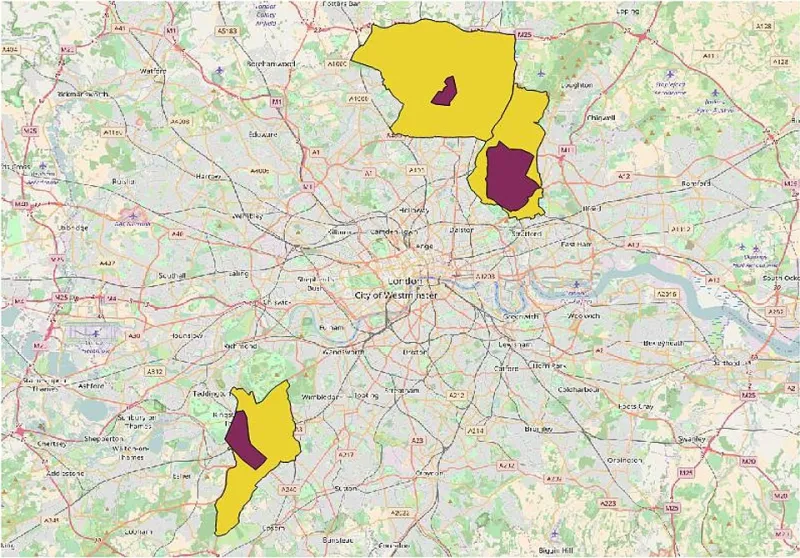
Photo: Authors of the study: Rachel Aldred, Anna Goodman, James Woodcock, CC BY 4.0, via Wikimedia Commons
When Londoners compare rents, they usually compare one number with another. A flat in Barking is set against a flat in Balham; a room in Croydon against a room in Clapham. The exercise is useful, but it is incomplete. Rent is only one price in a household budget, and it is not always the price that decides whether a week feels manageable or precarious. The cost of doing ordinary things — washing clothes, repairing a phone, buying a bag of rice, printing a form, collecting a parcel — matters just as much. In 2026, as some of London’s cheaper rental districts lose the low-cost services that once made them workable, that gap deserves closer attention.
Why headline rent is an incomplete price
Affordability is often treated as a ratio: rent against income. That ratio remains important, but it cannot capture what a neighbourhood allows a resident to do cheaply. A tenant paying £1,250 a month in an area with a launderette, a repair café, a discount grocer and a staffed library may spend less each week than a tenant paying £1,150 in an area where every one of those services has closed. The second tenant may appear to have the better deal on paper while facing higher routine costs, longer journeys and more administrative friction.
This is not a argument for ignoring rent. It is an argument for measuring it more honestly. The everyday economy — the shops, workshops, counters and public buildings that support low-cost daily life — functions as informal affordability infrastructure. When it thins out, the cost does not disappear. It moves into travel, delivery fees, card charges, replacement purchases and lost time.
Mapping the everyday economy
For this audit, we looked at a sample of London neighbourhoods with below-borough-average rents, including parts of Barking and Dagenham, Croydon, Hounslow and Waltham Forest. The exercise was deliberately simple. Within a short walk of each selected high street or parade, we recorded the presence of launderettes, shoe and clothing repair shops, discount grocers, public libraries, parcel collection points and hardware or household-goods shops. We then compared those findings with tenant interviews and with council high-street policy documents published in 2026.
The pattern was uneven rather than uniformly bleak. Some parades retain a dense mix of low-cost services. Others have lost them quietly, one unit at a time, as rents and business rates have reshaped the tenant mix. A launderette becomes a nail bar; a repair shop becomes a vape store; a discount grocer becomes a convenience store with higher shelf prices. None of these changes is necessarily harmful in isolation. Taken together, they alter what a neighbourhood lets a household do without travelling or paying a premium.
What tenants told us
The interviews added texture to the map. A parent in Croydon described choosing a flat partly because a launderette sat at the end of the road. With no washing machine and a young child, the weekly wash was not a luxury but a logistical necessity. When the launderette closed in early 2026, the nearest alternative required two bus journeys. The rent had not changed. The household budget had.
A renter in Hounslow made a similar point about parcel points. Working shifts made home delivery unreliable, and a nearby counter had provided a secure fallback. Its closure pushed her towards lockers further away and, in some cases, towards paid redelivery. These are small sums individually. Over a year, they become a quiet surcharge on living in an area that looks affordable on a letting agent’s spreadsheet.
Several tenants also spoke about libraries as practical infrastructure rather than cultural amenities. Free printing, internet access, study space and warm seating were mentioned repeatedly. For people in temporary accommodation or shared housing, the library can function as a low-cost extension of the home. Its value is difficult to capture in rent statistics, but it is not difficult for residents to feel.
The high street as affordability infrastructure
Council high-street policy is beginning to acknowledge some of this, though not always in these terms. In 2026, several London authorities are using vacant-unit strategies, meanwhile uses and small-business rate relief to keep parades occupied. Some are funding repair cafés or supporting community-owned shops. Others are prioritising footfall through market days and public-realm improvements. These measures are welcome, but they are often assessed by vacancy rates and visitor numbers rather than by whether residents can still access cheap essential services.
A more useful test would be explicit. Before a council signs off a change of use or a regeneration scheme, it could ask what everyday functions would be lost and where the nearest affordable substitute sits. That is not a call for freezing high streets in amber. It is a call for seeing service loss as an affordability question, not merely a retail one.
A different ledger for London
The case for a broader affordability ledger is practical. London’s housing debate is rightly focused on supply, rent levels and security of tenure. But tenants do not experience those issues in isolation. They experience them through the weekly shop, the laundry load, the broken phone, the parcel that must be collected, the form that must be printed. A neighbourhood that supports those activities cheaply is doing real affordability work.
In 2026, that work is unevenly distributed. Some cheaper rental areas remain well served. Others are becoming cheaper only in headline terms while becoming more expensive in daily life. The distinction matters for tenants choosing where to live, for councils shaping high streets and for anyone serious about measuring what London housing actually costs. The corner shop, the launderette and the library counter may not appear in rent tables, but they belong in the affordability conversation all the same.