Above the Platform: London’s Air-Rights Housing and the Affordability Reckoning

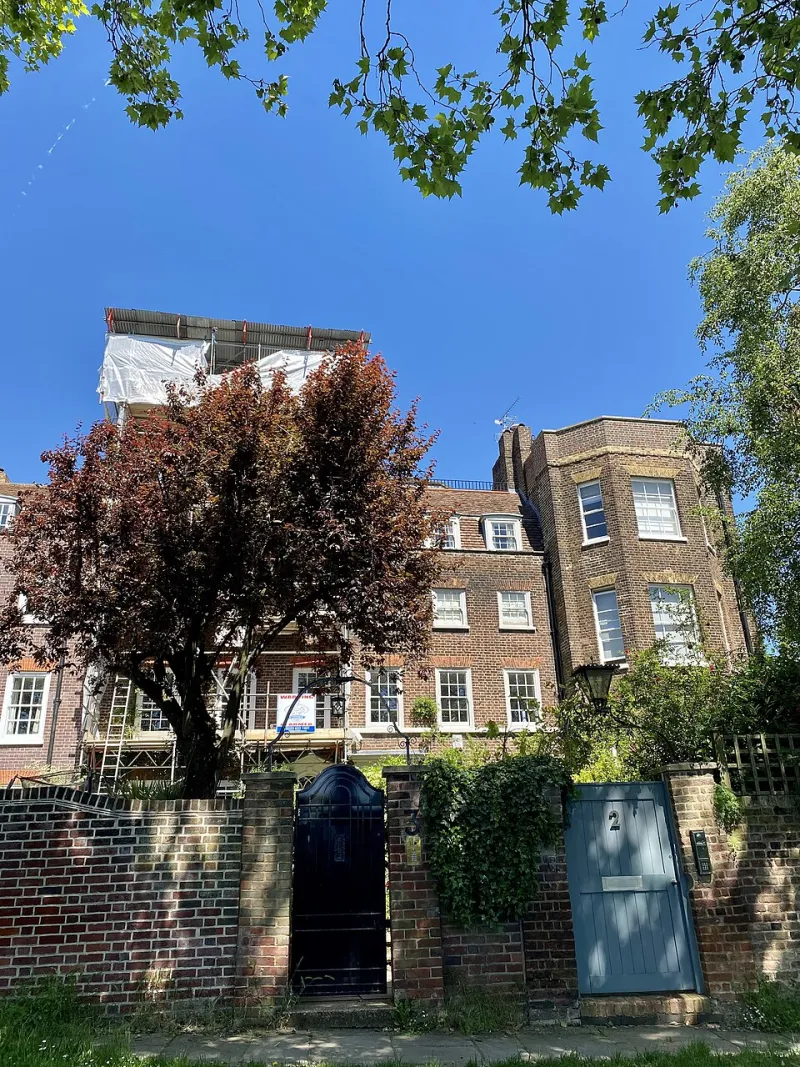
Photo: marktristan from Bristol, UK, CC BY-SA 2.0, via Wikimedia Commons
London’s housing debate has spent years looking sideways: to the green belt, the grey belt, the empty office, the underused car park. In 2026 it is increasingly looking up. Air rights — the legal capacity to build above an existing station, depot, supermarket or residential block — are being presented by public landowners and developers as a way to add homes without acquiring new land. The argument is seductive in a city where the cheapest asset is often the space already in public ownership. But the affordability question is not answered by the height of the scheme. It is answered by who owns the sky, who pays for the structure beneath it, and who bears the disruption while the cranes are up.
What air rights actually transfer
Air rights are not a simple freehold of the atmosphere. In practice, a scheme above a station or depot depends on a lease or development agreement with the landowner, structural capacity in the existing asset, rights of light, fire safety, acoustic separation and lift access. Transport for London, boroughs and housing associations have all been examining how to monetise the space above their assets without compromising the transport or social infrastructure below. In some cases the public sector retains the freehold and takes a ground rent or receipt; in others it sells a long lease and the uplift is captured once, at the point of sale.
The distinction matters for affordability. If the public landowner retains a stake, it can attach covenants, nominate affordable homes or reinvest receipts. If it sells outright, the affordable housing test falls back on the planning system — and on a viability assessment that is often produced by the applicant. The question for 2026 is whether air-rights schemes are being used to cross-subsidise homes at social rent, or to convert public land into a one-off capital receipt while the affordability obligation is negotiated downward.
The promise ledger
Several current London schemes illustrate the pattern. A rooftop extension above an existing residential block may deliver a small number of homes, but the abnormal costs are real: strengthening floors, new cores, fire-rated separation and lift overruns. Developers argue these costs reduce the viable affordable contribution. That may be true in individual cases, but the argument is rarely tested in public with the same rigour as the structural calculations. Where a scheme sits above a public depot or station, the land value is also shaped by the transport asset below, not by a competitive land market.
Planning promises therefore need to be read closely. Is the affordable housing on the same site, or off-site? Is it social rent, London affordable rent or intermediate? Is it a commuted sum paid years later, and if so, at what indexation? In 2026, the Mayor’s London Plan remains the benchmark, but the route from policy to delivery runs through section 106 agreements, viability reviews and grant funding. Air-rights schemes are particularly prone to being described as ‘complex’, which can become a reason to accept a lower contribution without a clear public account of the trade-off.
Daylight, construction and the neighbours below
Less discussed is the effect on people already living under the scheme. Rooftop development can alter daylight and sunlight to lower floors, change the outlook from existing flats, and introduce new plant, lifts and communal areas into service-charge calculations. Leaseholders may face major works consultation under section 20, but consultation is not the same as consent. Tenants in social housing may have less ability to move if construction noise, scaffolding or temporary loss of amenity becomes intolerable.
The construction phase is also an affordability issue. A household on a low income cannot easily absorb months of noise, dust or restricted access. Nor can a leaseholder easily absorb a sudden increase in building insurance or service charges if new rooftop plant is added to the building’s risk profile. These are not arguments against building upward. They are arguments for making the full impact part of the planning balance, rather than treating the roof as a free site and the people below as a residual concern.
Who captures the vertical premium?
Air rights create value because London land is scarce and transport connectivity is valuable. The public sector is entitled to capture some of that value. The question is how. A ground rent or overage clause can give the public purse a share of future uplift. A covenant can require a proportion of homes at social rent. A design code can protect daylight and shared amenity. But these tools only work if they are used before the land is sold, and if the public body has the capacity to monitor them afterwards.
There is also a community-development dimension. Some boroughs are exploring whether air-rights receipts can be ring-fenced for estate improvements, community facilities or affordable housing on nearby sites. That is a more defensible model than a one-off sale, because it connects the new homes above with the public infrastructure below. It also makes the affordability claim auditable: residents can see what was promised, what was paid and what was built.
A test for 2026
Three practical tests would sharpen the debate. First, public landowners should publish an air-rights register showing the asset, the lease length, the receipt or ground rent, and the affordable housing attached. Second, planning committees should require daylight and sunlight assessments to be summarised in plain English, with the impacts on existing lower-floor homes stated explicitly. Third, viability assessments for air-rights schemes should separate abnormal structural costs from ordinary development costs, so that ‘complexity’ cannot become a blanket discount.
Rooftop development can add homes. It can use public land more efficiently. But it is not a substitute for a serious affordable housing strategy, and it is not a land-value workaround that avoids hard choices. If London is going to build above its stations and blocks, the affordability ledger must be as visible as the skyline. Otherwise the city will have found a new way to build upward without answering the question that matters most: who can actually afford to live there.